My 2025 in Books
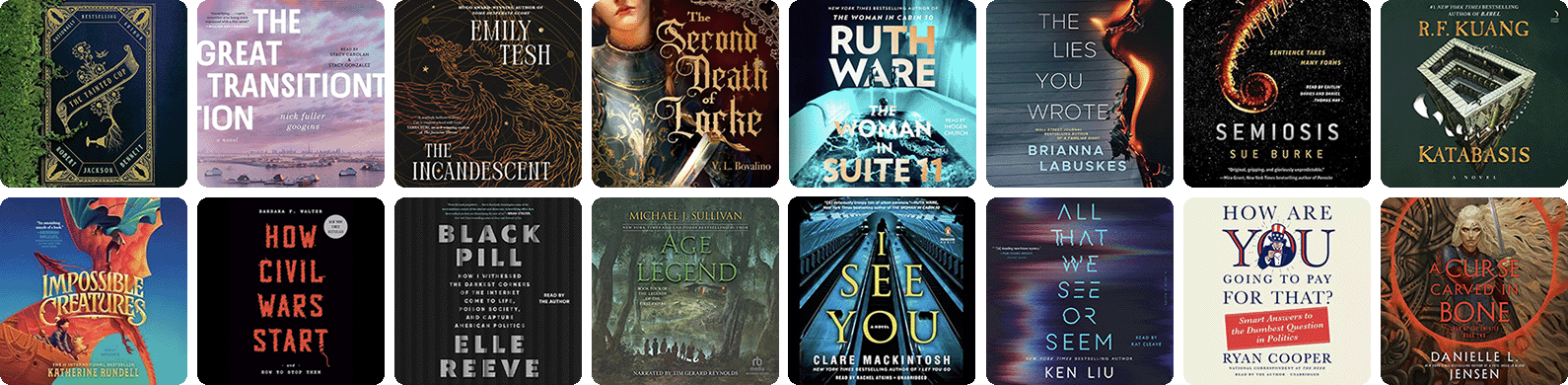
This year I set a goal of 50 books read. I passed that goal at the beginning of October, I think, when I finished one of my favorites of the year, The Incandescent by Emily Tesh. With a few days left, I’m at 66 books read this year, every single one of them an audiobook.1 My “Read” pile grows slowly; my “To Be Read” pile grows much faster, and I try not to think about the fact that it is probably already impossible for me to read everything in my TBR pile with the days left in my life. But here’s a little retrospective on what I’ve read this year, including my Top 5 for the year.
If you look at the breakdown of my ratings, you can see that I skew toward 4 and almost never give 1 star. I try not to DNF books and generally feel, personally, like if I DNF’ed the book, I don’t really have the right to judge it, as a book can be made or broken by the way it ends. I think of my rating system something like this:
- Terrible. Few redeeming qualities.
- Not good. Lots of problems, generally distributed across the writing, the characters, and the concepts at play.
- Fine. Not great, but I generally enjoyed my time reading it.
- This is a good book. It has some shortcomings, but I thoroughly enjoyed it and would recommend it.
- This is a fantastic book. I will be thinking about it for a long time, and it’s a book I’ll compare other future readings to.
For what it’s worth, I think in fiction, even the worst book is generally admirable: it takes a fair amount of thought and effort just to put enough words in order to make a novel.2 But if I find any value in a book, I’m going to have a hard time rating it below a three, even if it’s deeply flawed. In fact, that one star review I linked above was impulsive and, in retrospect, probably unfair.
And I’ve evolved a lot since college, when I was the type of person who would end friendships over matters of taste (yeesh); but I have generally been consistent in trying to recognize a distinction between “good/bad”— a somewhat detached assessment of the quality, craftsmanship, and impact of a piece of media—and “I liked/didn’t like this”, which is obviously much more subjective. I like many things I don’t think are actually particularly “good”—in that I think they’re not the most carefully-made, or original, or artful—and I dislike or didn’t find value in a few things that I think probably are.
With all of that in mind, my top five books that I read in 2025 (not necessarily books published this year) are generally books that I do believe are good, well-made pieces, but more importantly they’re things that really resonated with me or at least I had a lot of fun reading them. These are not just my five top-rated books, though; I’m also trying to select for range, at least a little. Fantasy dominated my reading this year so if I didn’t, books like The Second Death of Locke and Impossible Creatures would also probably make the list.
My Top 5 Reads in 2025
- The Tainted Cup, by Robert Jackson Bennett: an atmospheric fantasy mystery that absolutely sticks the landing. I was really enjoying this book—I’m a big fan of a good mystery, and the fantasy backdrop felt both familiar and new; but it was really the way the book wrapped up that helped me understand why it won the Hugo this year.
- The Great Transition, by Nick Fuller Googins: I had this one on my TBR for a minute and I kind of dreaded going in, because I expected something dense and depressing; it wasn’t that at all. It’s a very enjoyable read that also manages to discuss some really heavy concepts, going beyond the basic worries of climate change and thinking about how to live a life during and after upheaval, and presenting two conflicting perspectives on what comes after—essentially “learn how to live again” vs “constant vigilance, the fight is never over”—and did a really good job not straw-manning or undermining either perspective. And it ties it all together with a very engaging kind of thriller plot.
- The Incandescent, by Emily Tesh: speaking of Hugos, Tesh won last year for Some Desperate Glory, which is now one more novel on my TBR pile. But this one upended the “magic school” format by approaching it from the perspective of a professor, tempering the mystical backdrop with the bureaucracy of a career in higher education. There’s also a very charming queer romantic subplot.
- How Are You Going to Pay For That?, by Ryan Cooper: I generally read fiction, but I have a pretty deep stack of non-fiction I want to have read, and this is one of the ones I managed to get through this year. It’s very accessible and provides a ton of data that mostly boils down to “we can pay for whatever is important to us; choosing not to pay is just signaling that it is not important to us, as a society.”
- Semiosis, by Sue Burke: I love first contact stories. I think they’re unique in that they don’t necessarily need a standard plot: the plot is experiencing the new civilization. It’s why one of my all-time favorite reads is Maria Doria Russell’s The Sparrow, almost completely separate from the whole exploration of theodicy. Burke’s novel had been on my list for a while, and I’m glad I finally got to it. So many fictional alien civilizations are too similar to humankind—often bipedal, speaking via sound waves, etc—and Semiosis takes a very different and very interesting approach, with a central plot that also provides some compelling commentary on humankind, which is what science fiction does when it’s at its best.
Footnotes
-
For the record, listening to audiobooks is indisputably “reading” the book. ↩
-
LLMs are changing this, and I’ll be clear there too: using LLMs to write books is decidedly not admirable. I’m a big proponent of technology, a futurist in many ways, but using technology to replace art and devalue artists is anti-human and disgusting. ↩